
I have a little hobby. When I spot a guy in an airport or a hotel bar wearing a Bandon Dunes polo or a Pacific Dunes quarter-zip, I strike up a conversation. I ask about the trip. I ask his favorite course. And then I ask, casual as I can manage, whether he played Bandon Trails.
The number of times the answer is no should be a crime.
These are bucket list golfers. They flew across the country, drove the last stretch of Highway 101 through the fog, paid the freight, and walked the property for three or four days. And a stunning number of them never set foot on a top 100 course sitting right there in the same resort. That is like flying to Rome and skipping the Colosseum because you heard the gelato near your hotel was pretty good. Trails is not a throw-in. It is not the course you play if you have time. It is the one I would tell you to make time for.
So let me make the case.
It Is a Genuine Top 100 Course, and the Numbers Keep Climbing
In Golf Digest's 2025 ranking of America's 100 Greatest Public Courses, Bandon Trails comes in at number 11. Read that again. Eleventh. In the entire country. And for the first time in the history of the list, Trails jumped ahead of its neighbor Old Macdonald, which is no small feat in a resort stuffed with world-beaters.
Here is the part that should get your attention. Trails does this without a single hole on the ocean. The other four big courses at Bandon get to lean on the Pacific. Trails earns its spot the hard way, on architecture and routing alone. When a course can hang with the coastline heavyweights while playing entirely inland, you are looking at something special.
The architects were Bill Coore and Ben Crenshaw, which is roughly the golf equivalent of having the Coen brothers direct your home movies. The course opened in 2005, and it has aged like the good bourbon you will be drinking later.
A Completely Different Animal
Every golfer who shows up at Bandon braces for the same thing: wind, gorse, ocean, and the slow erosion of your ball supply. Bandon Dunes, Pacific Dunes, Old Macdonald, and Sheep Ranch all live on that wild stretch of coast and all of them will beat you up with the same weather.
Trails does not play that game. It plays up and down rolling terrain, lined with waste areas, fescue, and tall, mature pines that block the wind and quiet the whole experience down. You start in serious sand dunes, the routing turns inland through open meadow, then climbs higher into dense Oregon forest, and finally drops you back into the dunes to finish. Three distinct ecosystems on one walk. After three days of getting sandblasted on the coast, stepping into the trees at Trails feels like the course took pity on you. Then it reminds you that pine trees are ninety percent air, which is a lie golfers have been telling themselves since the dawn of the game.
The 14th: The View That Started Everything
If you only know one thing about Bandon Trails, know the 14th.
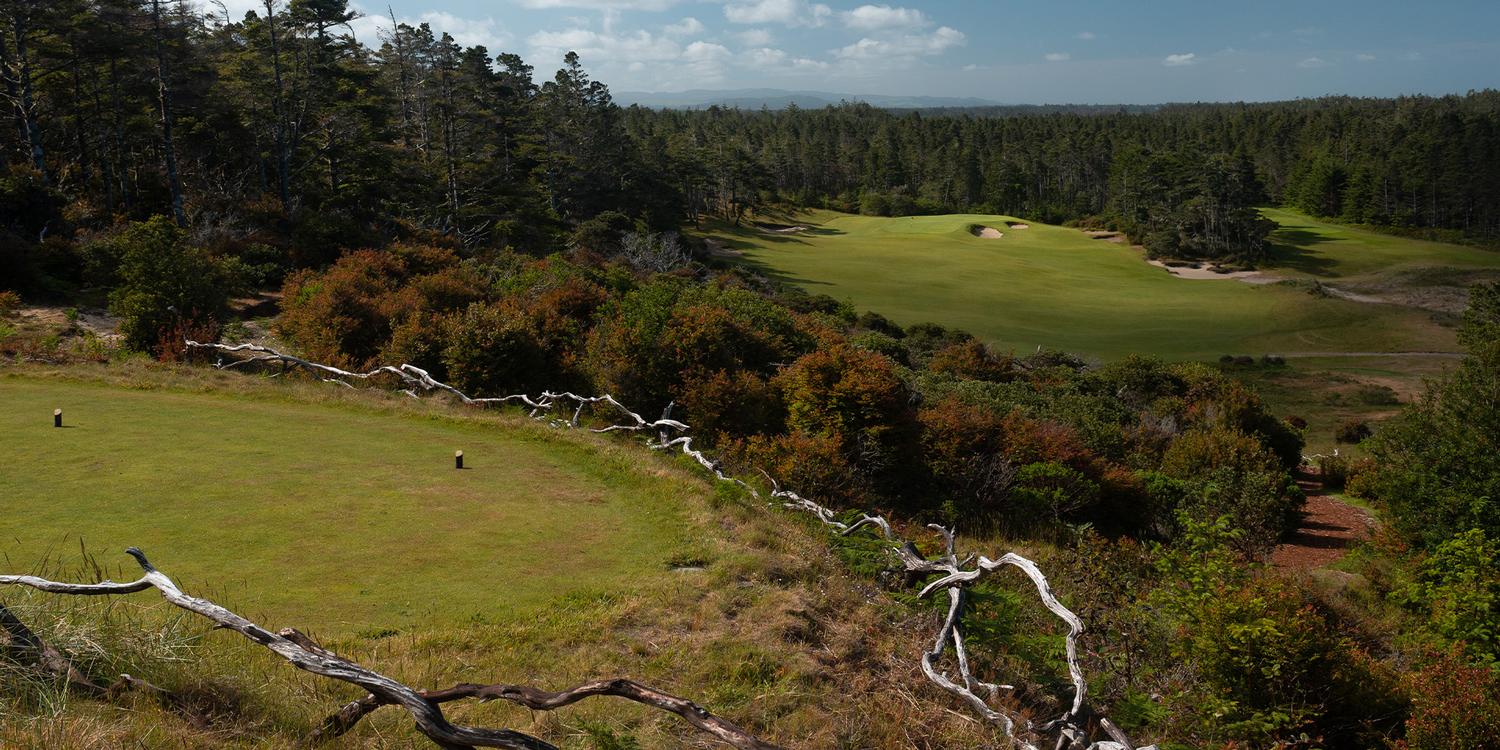
Walk behind the tee box and you will find a path leading to an overlook, and on that overlook sits a plaque. This is the spot. This is where Mike Keiser stood, looked out over the woods and the dunes and the ocean stretched out below, and decided to pull the trigger on the whole crazy idea. No Bandon Dunes, no Pacific Dunes, no pilgrimage, no resort at all without this view. The entire empire traces back to a guy standing on this bluff thinking yes.
The hole itself lives up to the address. The 14th is a downhill, driveable par 4 with something like a five-story drop off the bluff to a turtleback green far below. From the tee it whispers sweet nothings in your ear. Birdie. Maybe eagle. Just give it a smash and let gravity do the rest. So you do, and a few shots later you are writing down a number that starts with a five or worse, because that turtleback green sheds a good shot the way a barn roof sheds rain. Crenshaw shaped the green personally. The hole design actually came out of a Golf Digest Armchair Architect contest, and Keiser himself calls it his favorite hole on the entire property. The man built five world-class courses and this is the one he loves. That should tell you something.
Two Par 3s Worth Framing
The 5th and the 17th are the kind of par 3s that end up as the screensaver on your work laptop, a daily reminder that you should be there instead of here.
The 5th plays to a Biarritz green that runs close to 50 yards long, with a deep swale carved straight across the middle of it. Hit the wrong tier and your birdie putt becomes a small geography lesson. The 17th is the one the painters and photographers fight over, a downhill beauty with a false front feeding up to a tabletop green and a tightly mown fall-off back right just waiting to ruin your afternoon. Coore and Crenshaw are openly proud of the bunker they built short and right of it, and once you stand on the tee you will understand why.
After the Round: Poke Bowls and a Firepit
Here is a tip that will make you look like you have done this before. When you finish at Trails, do not bolt back to the lodge. The clubhouse restaurant, Trails End, is a Pacific Rim and Japanese-inspired spot, and it is the best change-up at the entire resort. After three days of clam chowder and burgers you will weep with joy at an Ahi poke bowl, a bowl of miso ramen with chashu pork, or the bulgogi beef. Grab a seat on the multi-level terrace, post up by the firepit, and look out over the 18th green with the dunes rolling away to the sea. Order something cold. Argue about the 14th. You earned it.
The Bottom Line
You flew all this way. You bought the gear. You took the trip of a lifetime. Do not be the guy I corner in a hotel bar two years from now who sheepishly admits he skipped a top 11 public course in America because the tee times got complicated.
Play Bandon Trails. Walk back behind the 14th tee and stand where Keiser stood. Take your swing at the driveable par 4 and accept whatever the golf gods hand back. Then go eat a poke bowl and watch the sun drop behind the dunes. Trails is not the supporting act at Bandon. On a lot of days, it is the headliner. Cross it off the list.